Rockhampton's climate and termites
Bureau of Meteorology records for Rockhampton Aero (from 1939) show an average of about 803 mm of rain a year, with most of it falling in the wet season from December to March. February is usually the wettest month, at about 139 mm. Summer average maximums are above 30°C, and the station sits at about 23.4° south, right on the Tropic of Capricorn.
Heat and moisture suit termites. After heavy wet-season rain, check for water pooling against the house, blocked gutters and downpipes, and damp under high-set homes. If your home is high-set on stumps, sound ant caps and clear access under the house make inspection much easier.
How termite risk changes across Australia
CSIRO says termite risk on the Australian mainland generally increases further north, with the highest risk in the subtropics and tropics, and most states have a moderate to very high risk of attack. Above the Tropic of Capricorn, the giant northern termite (Mastotermes darwiniensis) is a particularly destructive species. Tasmania is the only state CSIRO rates as negligible risk. CSIRO also notes that drywood termites, which live inside timber without needing contact with soil, are more common in humid areas such as tropical and subtropical Queensland and New South Wales.
Most damage in homes comes from subterranean termites. They usually need a connection to soil or a constant source of moisture, build mud shelter tubes to travel over things they can't eat, and generally forage within 30 m of their nest, though sometimes 100 m or more.
Business Queensland lists Coptotermes acinaciformis and Schedorhinotermes species as found throughout Queensland, with the giant northern termite in tropical northern Queensland. Rockhampton sits right at the Tropic of Capricorn, the line CSIRO uses when describing where the giant northern termite is a concern.
Drywood termites in Queensland
Business Queensland says the West Indian drywood termite (Cryptotermes brevis) has been found throughout Queensland. It lives entirely inside timber and can be moved in infested furniture or timber. CSIRO says that if drywood termites are found in Queensland, the Queensland Government should be told. Business Queensland also lists exotic Coptotermes termites as prohibited matter that must be reported immediately (call 13 25 23).
Signs to look for
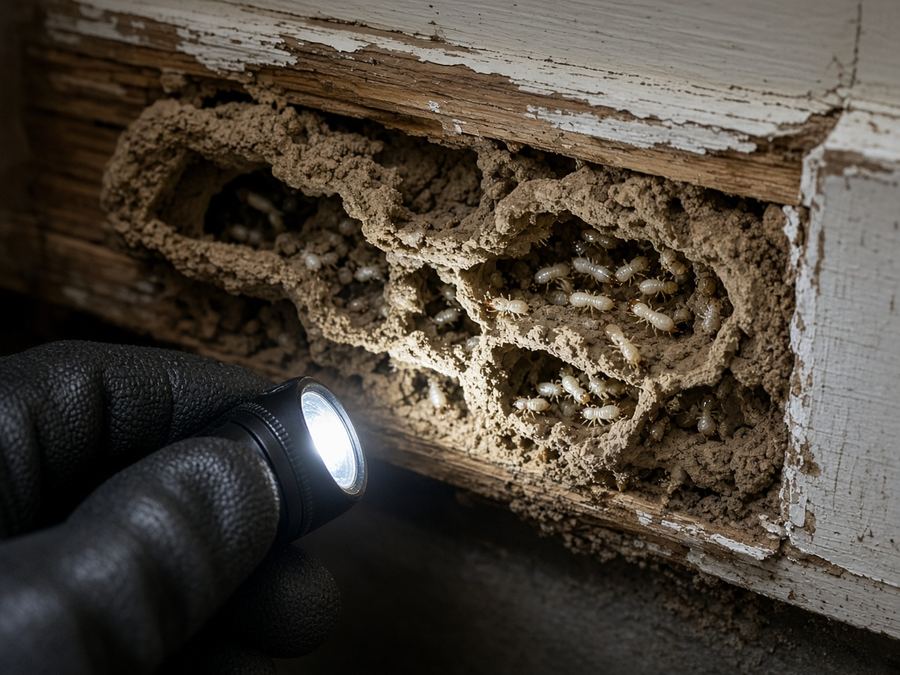
- Mud shelter tubes on stumps, ant caps, slab edges, brickwork or inside walls.
- Hollow-sounding timber in skirting boards, door and window frames, and posts set in the ground.
- Mud packed into joints and cracks in timber.
- Damp or stained areas, especially around bathrooms, laundries and places where paving sends water towards the house.
- Winged termites (alates) swarming, particularly from inside the house.
- Small piles of gritty pellets under tiny holes in timber, which can point to drywood termites.
If you find activity, don't spray it or break open the workings. Disturbing termites can make them move and harder to treat. Leave it for the technician.
Lowering the risk around a Rockhampton home
For high-set and low-set homes alike, CSIRO's guidance includes:
- Keep garden beds, soil and mulch away from walls and below the slab edge and weep holes.
- Fix leaking taps, pipes, showers and air conditioner drains, and make sure ground and paving slope away from the house.
- Don't stack firewood or timber against the house or under a raised floor.
- Keep subfloor vents clear so the area stays dry and can be inspected.
- Make sure renovations, new paths and extensions don't bridge an existing termite barrier.
- Look in the meter box for the durable notice about the termite management system installed, and keep any paperwork from past treatments.
Treatment options a technician may suggest
Common approaches include chemical soil barriers around the slab, footings and stumps, physical barriers such as stainless steel mesh, graded stone and ant caps (usually installed during construction), baiting systems that are checked regularly and used to carry an insecticide back to the colony, and direct treatment of active termites with dusts or foams. Organochlorine chemicals were banned in Australia from 30 June 1995, so older treatments won't still be protecting a house. The technician should explain what they recommend, why, and how it will be maintained.
How often to inspect
The QBCC recommends a termite inspection at least every 12 months, and more often in high-risk areas. CSIRO also recommends inspections at least once a year. Treatments don't give permanent protection against new colonies, so regular inspections matter even after a barrier has gone in. See what to expect from a termite inspection.
Get a quote
Choose "Termites: inspection" or "Termites: treatment or barrier" in the quote form. We pass it to one licensed local pest management operator who holds the licence for timber pest work, and they quote for your job. It's free and there's no obligation.
Where this information comes from
- Bureau of Meteorology: climate statistics, Rockhampton Aero (039083)
- CSIRO: Managing termites (Building Technology Resources, PDF)
- Business Queensland: subterranean and drywood termites
- Business Queensland: West Indian drywood termite
- QBCC: Termite management systems, for homeowners and builders (PDF)
Licensing rules and government advice change. Check with the regulator before you rely on them.